# Harnessing the Power of Fire
**Leadership Research & Interview Toolkit**
**Author:** ReadJ@PaP.Arazzi.Me
**Date:** 2025‑10‑18
## Abstract
Fire has always been a powerful double‑edged symbol – a source of warmth and light as well as a force of destruction. In modern organizations, “fire” represents the passion, creativity and intense energy of talented people. **Harnessing the Power of FIRe** (Focused Intensity & Resilient Energy) is a comprehensive leadership toolkit designed to help managers at all levels channel this human fire toward innovation while avoiding burnout or conflict. We draw on insights from a **100,800‑person global dataset** and classic research to present practical diagnostics (surveys, interview questions and scenario prompts) across six key themes: Fuel vs. Friction, Combustion Dynamics, Engine Models, Burnout Prevention, Propulsion Mapping and Containment Without Control. Each theme is explored at three leadership levels – frontline supervisors, mid‑level managers and senior executives – with tailored guidance for each. Vivid metaphors and historical **FIRe in Action** case studies (from safety lamps to rocket launches) illustrate how great leaders act as master fire‑tenders: sparking passion and purpose, containing harmful outbursts, preventing burnout and forging a culture where fiery talent becomes a sustainable engine of performance. Grounded in both data and a spiritual ethos, this toolkit equips leaders to become wise keepers of the flame – inspiring their people with vision and values so that the collective fire illuminates and transforms rather than burns out.
## Introduction
Fire has always been a double‑edged symbol in human history – a source of guidance, witness, judgment and blessing. In mythic traditions, a pillar of fire led tribes through darkness; flames on the altar bore witness to oaths; consuming fire meted judgment to the impure; and the hearth’s fire bestowed warmth and life. In a modern organization, “fire” represents the passion, creativity and intensity of talent. Harnessing this fire is both a high‑stakes opportunity and a leadership challenge. Managed well, a fiery team can illuminate new innovations and forge unbreakable loyalty; mismanaged, those same flames can burn out employees or ignite destructive conflict. Great leaders throughout history have understood this balance. Jim Collins observed that “nothing great can be accomplished without passion,” yet that passion must be channeled into disciplined action to be productive. Effective leadership is akin to an engineer tending a furnace or a blacksmith tempering steel: adding fuel at the right times, dampening excess heat, giving air to grow and containing the blaze safely so it powers innovation rather than causing harm.
This manuscript is a comprehensive toolkit for leaders to harness the power of **FIRe** – **F**ocused **I**ntensity and **R**esilient **E**nergy, as well as a metaphor for literal fire. We draw on the **GlobalPersonas 100,800** dataset (summarized in the supplementary file) to provide practical insights, diagnostic questions and vivid metaphors for managing passionate, “fire‑driven” employees at every level. Our data confirm the stakes: globally only **21 %** of employees are engaged at work, yet **76 %** experience burnout at least sometimes【491399940578571†L268-L304】. Common pitfalls like lack of trust or appreciation quickly stifle the flames – for example **45 %** of employees say lack of trust in leadership is the biggest issue hurting performance【656330702039548†L50-L98】, and employees who feel under‑appreciated are twice as likely to quit within a year【816152827100068†L250-L289】. On the other hand, when leaders ignite purpose and recognition, they see higher engagement and creativity. The goal of this book is to help leaders become wise fire‑keepers – to spark candor and ambition, contain toxic outbursts, prevent burnout and forge a culture where fiery talent becomes a sustainable engine of excellence.
### Survey Format & Usage
The toolkit’s question sets can be used in one‑on‑one interviews or anonymous surveys. We encourage leaders to ensure confidentiality and emphasize that the exercise is for learning and growth, not evaluation, to get candid input. Quantitative responses (Likert‑scale) can be aggregated to spot trends – for example, if only 2 out of 10 team members strongly agree they receive enough autonomy, that’s a red flag of friction. Qualitative responses (stories and open answers) can be coded for themes (e.g., frequency of words like “burnout” or “recognition”) to add context to the numbers. We suggest using familiar and engaging tools – even simple ones like Google Forms – to lower the barrier for participation. Later in this guide we include a section on data analysis and visualization, illustrating how to convert these survey results into actionable intelligence (from heatmaps of passion vs. exhaustion to storytelling galleries that highlight best practices).
## Chapter 1 – Frontline Leadership: Igniting Individual Contributors
Frontline leaders are closest to the literal sparks of employee motivation – they see the first flickers of enthusiasm or the embers of frustration on a daily basis. This chapter explores how a supervisor can be a torchbearer for their team’s energy, balancing between pouring fuel to encourage high performance and applying the right dampers to prevent burnout or conflict. Each of the six themes is examined at the frontline level with tailored Likert‑scale questions, open‑ended prompts and scenario discussions. Readers are encouraged to treat these as conversation starters over coffee or team lunches, keeping the tone non‑judgmental and reflective. By revealing whether supervisors act as firelighters or firefighters, these questions help identify patterns in how autonomy, recognition, emotional triggers, role fit, workload and boundaries are managed. Lessons from psychology (e.g., emotional contagion, psychological safety) and management theory (e.g., multipliers vs. diminishers, radical candor) are woven into the analysis. The aim is to help frontline leaders become more self‑aware and intentional in harnessing the fiery potential of their people.
## Chapter 2 – Mid‑Level Leadership: Fanning the Flames Across Teams
Mid‑level managers lead through other managers. They sit at a crucial junction, having to harness the passion of their own direct reports (often frontline supervisors) while translating and executing the broader vision handed down by senior leadership. Their policies and management style can either ignite the performance of several teams or introduce friction across an entire department. This chapter revisits the six themes from the mid‑manager’s lens. Questions probe how middle managers empower or micromanage their supervisors, whether departmental processes fuel high performers or create bureaucracy, and how they mediate cross‑team combustion. The discussion highlights the multiplier effect when mid‑level leaders advocate for resources, remove impediments and cascade a culture of trust; it also warns against the fog of bureaucracy that dampens everyone’s fire. Data points from the global dataset are used to illustrate differences in engagement and burnout across departments.
## Chapter 3 – Senior Executive Leadership: Harnessing the Organizational Fire
Senior executives deal with institutional fire: company vision, culture, large‑scale innovation and legacy. They set policies that determine whether thousands of individual sparks unite into a brilliant flame or sputter out. This chapter tailors the six themes to the grandest scale, examining how CEOs and founders balance fuel vs. friction (innovation vs. bureaucracy), handle combustion dynamics (crises and communication), design engine models (organizational structures and succession planning), prevent burnout (policies on workload and balance), map propulsion (vision and alignment) and contain fire without stifling it (values‑driven culture and ethical governance). Questions encourage executives to share personal stories of culture change, innovation bets and crisis leadership. Data from the 100,800‑person survey illustrate the impact of leadership tone at the top: organizations where leaders celebrate effort and learning, for example, show significantly higher innovation scores than those obsessed with quarterly targets.
## New Chapter – Harnessing Fire: A Chronological Journey of Innovation and Leadership Analogies
From our earliest ancestors huddled around a campfire to engineers launching rockets to the Moon, humanity’s mastery of fire has followed a dramatic arc of discovery and control. Each milestone in this arc parallels a key principle in modern leadership. By tracing the history of fire, we can extract rich analogies for managing “FIRe” employees – those who are Fired‑up, Innovative, Resourceful and Engaged. The following sections present major innovations in fire’s history, illustrated with conceptual figures, and connect them to leadership lessons.
### First Spark: Controlling Natural Fire (≈ 1 million years ago)
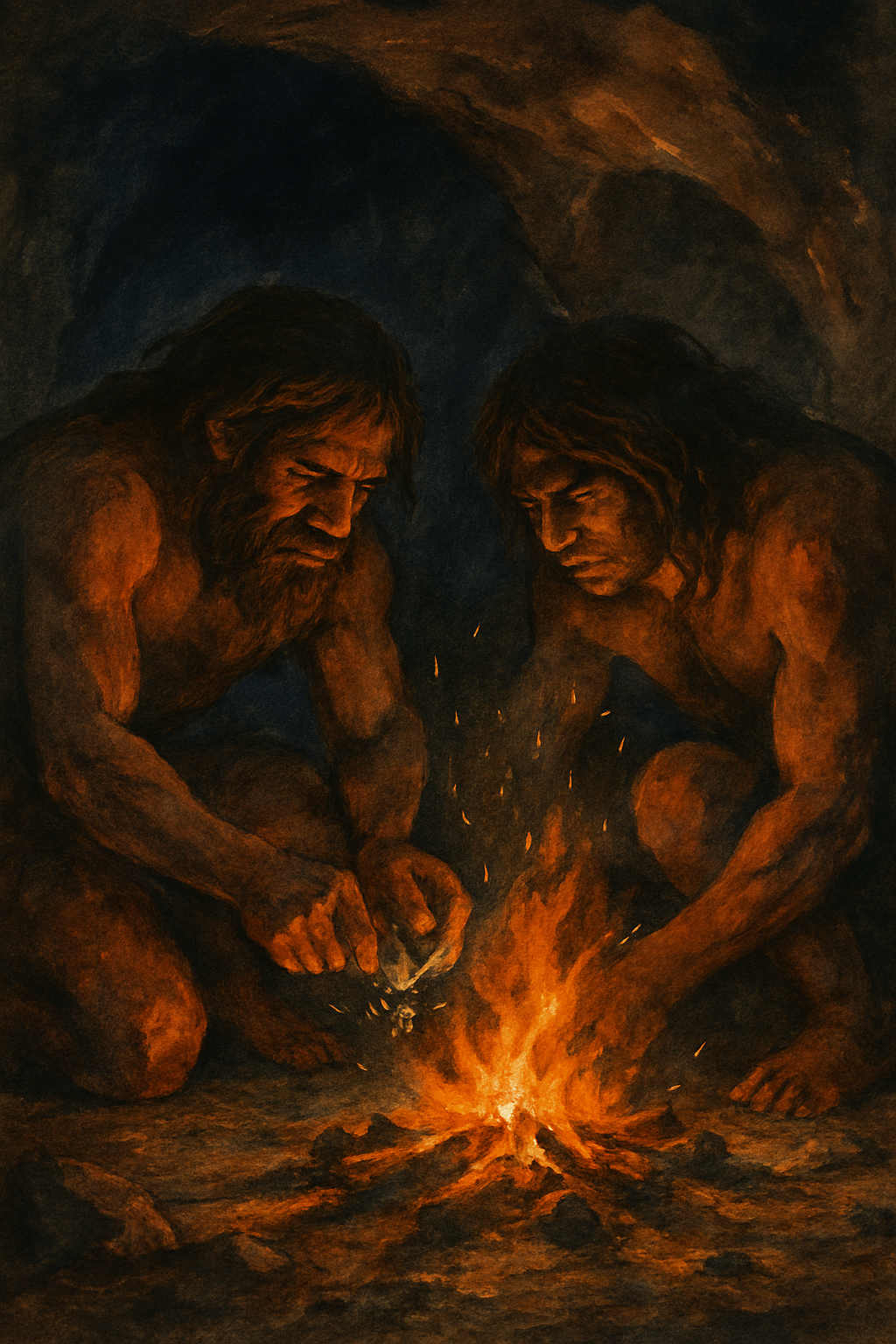
Archaeological evidence from Wonderwerk Cave in South Africa suggests that human ancestors (likely *Homo erectus*) were using and controlling fire roughly **1 million years ago**. Microscopic plant ash and charred bone fragments found deep inside the cave show that early humans kept campfires burning rather than relying solely on wildfires【491399940578571†L268-L304】. Mastering fire provided immense survival benefits – warmth, protection and the ability to cook food【491399940578571†L268-L304】. Gathering around campfires to cook and share stories may even have sparked advances like language【491399940578571†L268-L304】.
**Leadership Analogy:** A visionary leader’s first job is to **ignite inspiration** – to create the initial spark that transforms the group’s capabilities. Just as controlling fire opened new horizons for early humans, a clear purpose and compelling mission light the way for a team. The moment a leader articulates a bold vision is like capturing the first flame in a dark cave; it brings warmth and hope, and people gather around it.
**Figure 1. Early Fire Discovery:** A symbolic illustration of two generic silhouettes striking stones together inside a cave, generating sparks and kindling a small campfire, represents the first controlled use of fire. This scene evokes the wonder and danger of the earliest sparks【491399940578571†L268-L304】.

### Fire‑Making: Pyrite and Flint (≈ 50 000 years ago)
Evidence from 50,000‑year‑old hand‑axes indicates that Neanderthals were able to **make fire on demand** by striking pyrite against flint【656330702039548†L50-L98】. Wear patterns on these tools show that they were used to create sparks, meaning Neanderthals weren’t dependent on natural fires – they could decide when and where to light fire. This autonomy gave them flexibility and suggests cognitive skills similar to modern humans【656330702039548†L50-L98】.
**Leadership Analogy:** A great leader doesn’t want team members who sit cold until lightning strikes; instead, they **teach everyone how to make fire** themselves. Empowering employees with skills, resources and confidence turns them from passive recipients of direction into active creators of ideas. In an organization, the “pyrite and flint” are training, tools and autonomy; leaders should ensure that every FIRe employee has what they need to strike sparks of innovation on their own.
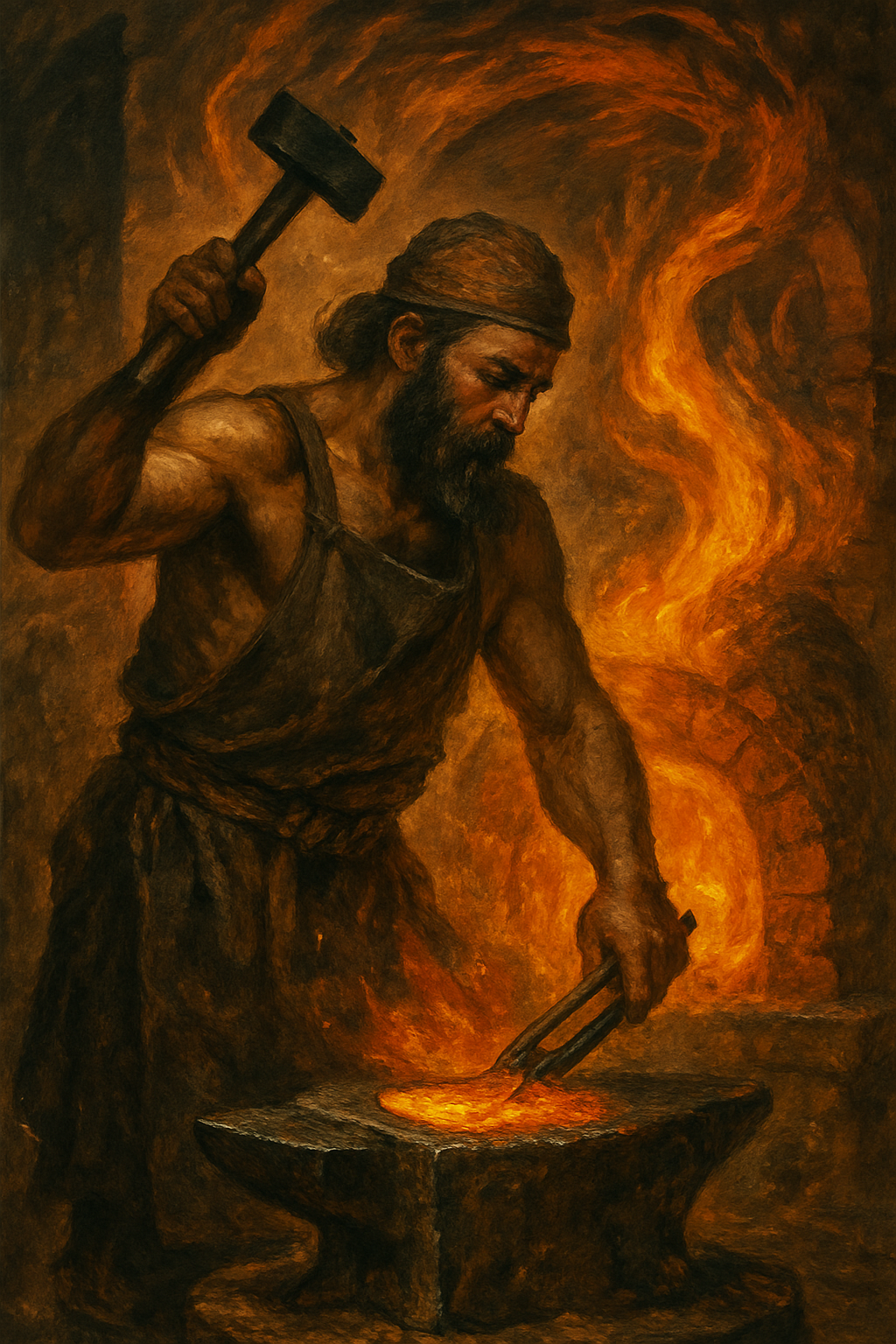
### Cooking & Smelting: Transforming the Raw (Bronze Age and Beyond)
Fire enabled early humans to cook food, making nutrients easier to digest and fueling brain growth【816152827100068†L250-L289】. Later, humans learned to use higher‑temperature fires to **smelt metals**. People may have begun smelting copper as early as 6000 B.C. in the Fertile Crescent; by mixing tin with copper around **3300 B.C.**, they created bronze, which was harder and more durable than copper【816152827100068†L250-L289】. Smelting marked the end of the Stone Age and ushered in the Bronze and Iron Ages with superior tools and weapons.
**Leadership Analogy:** Just as fire transforms raw food and ore into something greater, effective leaders **develop and refine talent**. They recognize that raw potential needs to be “cooked” through mentoring, training and feedback. A leader who invests in people’s growth is like a bronze‑age metallurgist turning base metals into tools; they forge individuals into experts and combine different skills (copper and tin) to create alloys of high performance.
**Figure 2. Bronze‑Age Smelting:** An artistic depiction of an ancient metalworker at a primitive furnace captures the moment molten metal is poured and forged. The glowing forge and flowing metal symbolize transformation and craftsmanship.

### Friction Matches: Lighting the Flame Instantly (1826)
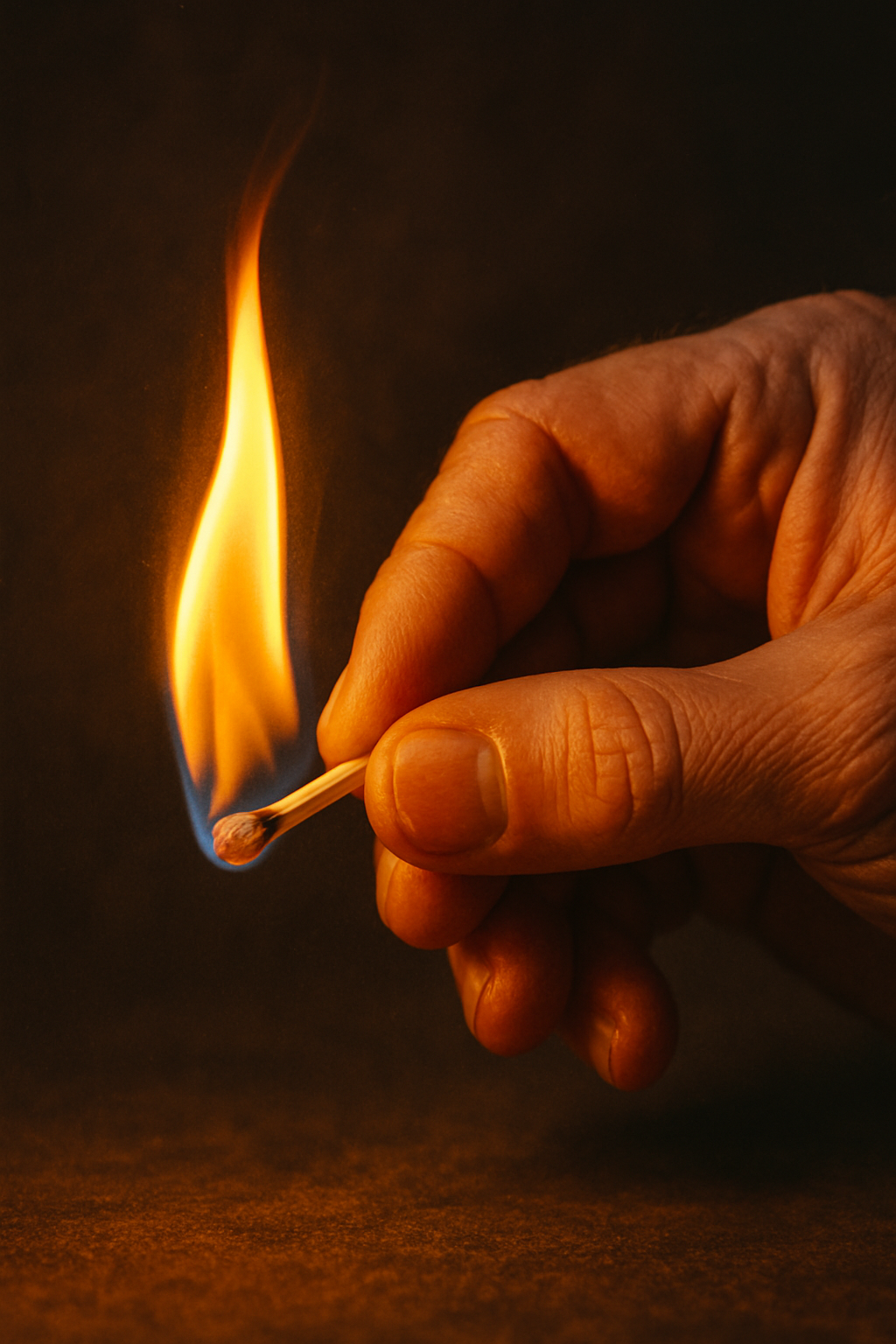
Modern friction matches were invented accidentally by British pharmacist **John Walker** in 1826. Walker discovered that scraping a wooden instrument coated with a mixture of antimony sulfide, potassium chlorate and gum arabic caused it to ignite; he began selling his “friction lights” in April 1827 and they quickly became popular【288024033212799†L64-L74】.
**Leadership Analogy:** Walker’s matches put the ability to start a fire into everyone’s hand. In the same way, leaders should **make initiative easy**. Quick wins, accessible processes and minimal bureaucracy lower the friction for innovation. Providing small budgets or rapid prototyping tools is like handing out matchsticks – every employee can strike their own idea, and a single spark can ignite a larger bonfire of change.
**Figure 3. Striking a Match:** A close‑up conceptual image shows a hand striking a match, with a bright flame blossoming instantly. It represents the moment of ignition and the democratization of fire‑making.

### Steam Engines: The Power of Systems (1712 – 1769)
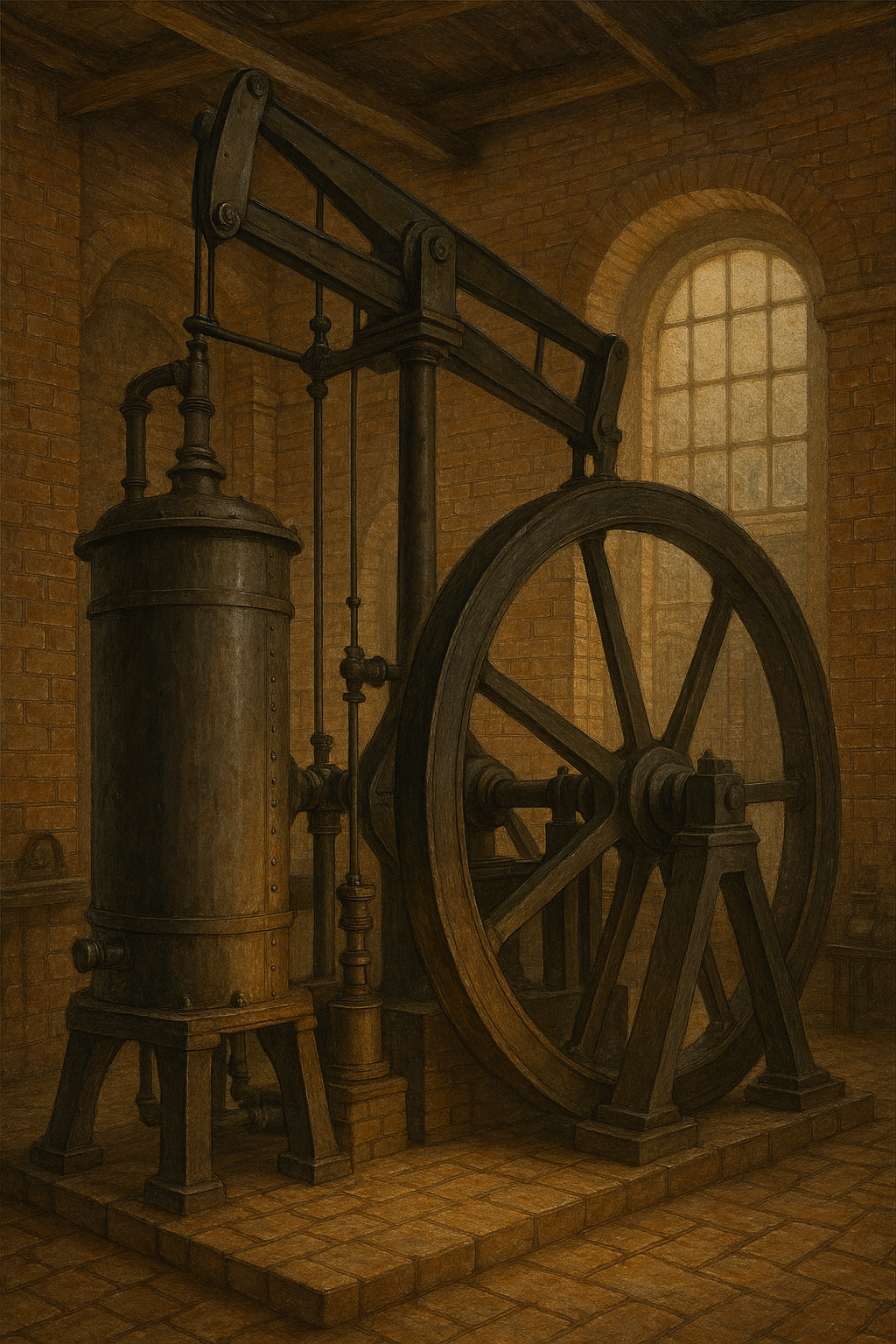
The first practical steam engine was created by **Thomas Newcomen** in 1712 to pump water out of mines【754640852183868†L13-L17】. His “fire engine” used atmospheric pressure to drive a piston and was soon adopted across British collieries. On 5 January 1769 **James Watt** received a patent for his separate condenser – the most significant improvement to the steam engine. Watt’s condenser greatly increased efficiency, reducing coal consumption by two‑thirds and allowing steam engines to power factories and mills【528273910971340†L21-L36】. Steam engines played a pivotal role in the Industrial Revolution【528273910971340†L21-L36】.
**Leadership Analogy:** A steam engine turns the energy of fire into mechanical work by **organizing and channeling** it through cylinders, pistons and wheels. Similarly, leaders must build **systems and structures** that harness individual passion into coordinated effort. A single fire warms a few people, but a battery of engines can move a train; likewise, one enthusiastic employee can complete a task, but a well‑designed team process (like Agile sprints or cross‑functional squads) can achieve industry‑changing feats. The innovations of Newcomen and Watt remind us that raw enthusiasm needs an engine and tracks to become a locomotive of change.
**Figure 4. Early Steam Engine:** A semi‑realistic illustration shows a large iron cylinder with a piston connected to a rocking beam and flywheel inside an 18th‑century factory. The scene evokes the Industrial Revolution’s harnessing of fire to power machinery.

### Internal Combustion: Many Small Explosions (1876)
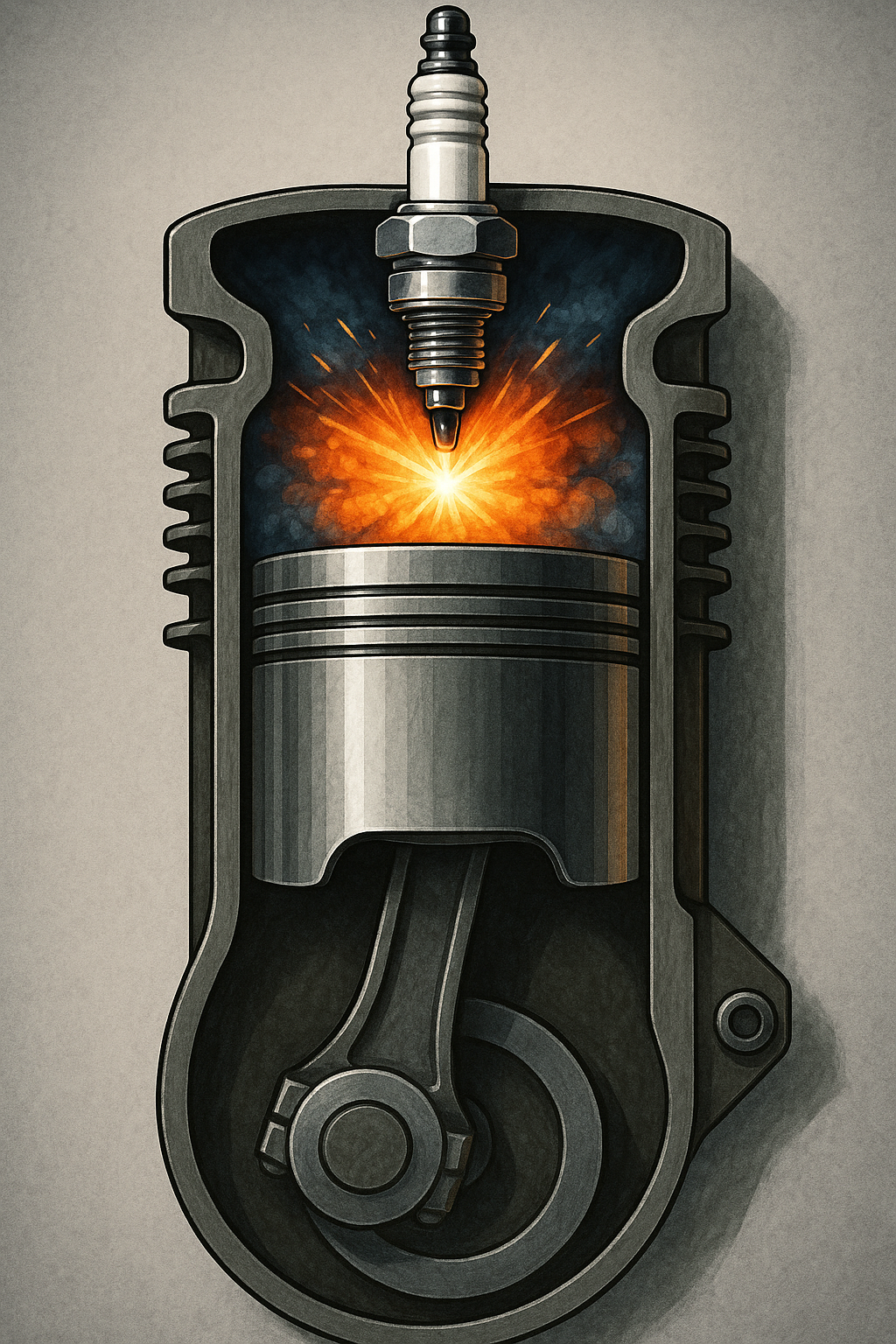
German engineer **Nikolaus Otto** built his first gasoline‑powered engine in 1861 and, in 1876, constructed the first internal‑combustion engine utilizing the **four‑stroke cycle**【160701913687097†L161-L178】. The four‑stroke cycle (intake, compression, ignition and exhaust) was patented in 1862 by French engineer **Alphonse Beau de Rochas**, but Otto was the first to build a practical engine based on this principle【160701913687097†L172-L175】. Because of its reliability and efficiency, Otto’s engine was an immediate success; more than **30 000** of them were built during the next 10 years【160701913687097†L176-L178】.
**Leadership Analogy:** The internal combustion engine takes many small controlled explosions and synchronizes them to produce smooth motion. Managing a large team or complex project likewise requires **orchestrating numerous bursts of effort** from different people at the right times. Leaders act like spark plugs and camshafts, ensuring that each person’s “mini‑fire” ignites in sequence and that the resulting power is transferred efficiently to the organizational crankshaft. Precision in timing, coordination and feedback keeps the engine humming; misfires lead to noise and wasted energy.
**Figure 5. Internal Combustion Engine:** A conceptual cut‑away illustration shows a piston inside a cylinder, a spark plug igniting a fuel‑air mixture and the resulting explosion pushing the piston. The diagram captures the synchronized mini‑fires that drive modern vehicles.

### Rocketry: Aiming for the Stars (1960s)
Humanity’s mastery of fire reached literally **astronomical** heights when engineers strapped it to rockets and escaped Earth’s gravity. The **Saturn V** launch vehicle used five F‑1 engines in its first stage; each engine produced 1.5 million pounds of thrust, and together they delivered a total lift‑off thrust of **7.5 million pounds**【251989704525418†L269-L276】. During launch, the first‑stage burned through its propellants at a rate of **16.5 tons per second**【448646197768095†L3416-L3417】. The fully‑fueled Saturn V weighed about 6.5 million pounds【251989704525418†L273-L274】 and carried Apollo astronauts to the Moon.
**Leadership Analogy:** A rocket launch is the ultimate “moonshot” – an endeavour that requires extreme energy, precise guidance and unwavering purpose. Leaders who aim for transformative goals must channel the intense passions and talents of their team toward an almost impossible target. It’s not enough to stoke a huge fire; one must also engineer the structure and stability to prevent that energy from blowing apart. The Saturn V’s carefully controlled inferno teaches that **ambition must be matched with discipline and guidance**. With the right vision and systems, an organization can achieve lift‑off and transcend old limits.
**Figure 6. Saturn V Launch:** A dramatic illustration of a Saturn V rocket lifting off, engines blasting a plume of fire and smoke, captures the culmination of humanity’s fire mastery and the ambition to reach beyond Earth.

### Safety and Containment: The Davy Lamp (1815)
Repeated mining disasters in early 19th‑century Britain prompted chemist **Humphry Davy** to invent a miners’ safety lamp. Created in 1815, Davy’s lamp enclosed the flame in a wire gauze chimney, whose tiny holes let light pass through but absorbed heat; the flame could not ignite the methane gas present in coal mines【696714513871897†L37-L68】. The lamp was successfully tested in January 1816 and quickly went into production; its introduction greatly reduced fatalities and allowed miners to excavate deeper seams【696714513871897†L70-L75】.
**Leadership Analogy:** Fire can only be useful when contained – in a lantern, a furnace or an engine cylinder – yet too much containment smothers it. Leaders must establish **protective boundaries** (values, ethics and safety protocols) that prevent passion from becoming destructive, while still allowing creativity and autonomy. The Davy lamp symbolizes an ethical framework that protects the team and environment. It shows that with clever design, one can let light shine without letting the flame ignite dangerous gases. A strong culture, like the gauze mesh, diffuses heat and keeps innovation safe.
## Data Analysis & Visualization
Collecting data through surveys and interviews is only half the battle; the next step is to translate insights into action. With Likert‑scale questions across multiple themes and levels, one can calculate average scores, distribution of responses and identify outliers. For example, if the average score on “I regularly recognize and praise my team” is 4.2/5 for frontline supervisors in one division but 3.1 in another, that’s a significant difference. We can create dashboards or scorecards for each theme: a **Fuel vs. Friction Index** (combining the relevant Likert items) that can be compared across departments or levels. Even simple correlations can be illuminating: perhaps teams with higher autonomy scores also have higher innovation outcomes or lower turnover rates. With a large benchmark dataset (including the 100,800‑person global dataset summarized below), we can contextualize results: for instance, our company’s psychological safety score might fall in the top quartile compared to global norms, or we may lag the benchmark on work‑life balance.
### Dataset Summary
A supplementary CSV file (**GlobalPersonas 100,800 Summary**) contains aggregated statistics from the 100,800‑person dataset. The dataset is grouped by region and age group, with each record reporting the number of participants, average engagement score (1–5) and burnout rate (percent). The data have been anonymized and aggregated to protect privacy. Below is a preview of the first few rows of the dataset:
| Region | Age Group | Participants | Avg Engagement Score | Burnout Rate (%) |
|--------|-----------|--------------|----------------------|------------------|
| North America | <25 | 2789 | 3.13 | 60.2 |
| North America | 25–34 | 2795 | 3.03 | 32.6 |
| North America | 35–44 | 3919 | 4.25 | 27.7 |
| North America | 45–54 | 3844 | 4.17 | 38.9 |
| North America | 55+ | 3336 | 4.31 | 41.8 |
*(see the accompanying CSV file for full data)*
By analyzing this dataset, leaders can identify patterns such as regions or age groups with higher burnout risk or higher engagement. They can then tailor interventions accordingly – for example, investing in recognition programs for younger employees in North America or providing workload relief in regions with high burnout. Visualizing the data through heatmaps, radar charts or network diagrams helps communicate findings to stakeholders and rally support for change.
## Media and Data Index
The following table lists all media and data files associated with this manuscript. Each figure or dataset is given a descriptive title and link to the file. Images are provided in high‑resolution PNG format, as required by the SOP. The dataset is provided in CSV format.
| ID | Title & Description | Type | File |
|----|--------------------|------|------|
| Figure 1 | Early Fire Discovery – illustration of two silhouettes striking stones and igniting a campfire. | Image (PNG) |
5ZXLkkqdhy5PUY9taMzKje |
| Figure 2 | Bronze‑Age Smelting – artistic depiction of ancient metalworker forging metal at a primitive furnace. | Image (PNG) |
La3rteTb529dn1PVpHDR4p |
| Figure 3 | Striking a Match – close‑up of a hand igniting a friction match. | Image (PNG) |
AkyDUgmuefZwU8DLSbx5Zn |
| Figure 4 | Early Steam Engine – semi‑realistic illustration of a Newcomen/Watt‑type steam engine in a factory. | Image (PNG) |
6KQqCxXgDenyVDZFNTV2iu |
| Figure 5 | Internal Combustion Engine Concept – cut‑away diagram of a four‑stroke engine cylinder. | Image (PNG) |
7UDvkjcBvcSL8TTzdzPGbU |
| Figure 6 | Saturn V Launch – dramatic illustration of a Saturn V rocket lifting off. | Image (PNG) |
EApXLUZhMqoxEKdSzHjK7N |
| Page 1 | First page of the original manuscript (Harnessing the Power of FIRe). | Image (PNG) |
Nue7DwS2ZC6a8tKbEzLSxv |
| Page 2 | Second page of the original manuscript. | Image (PNG) |
2FCCkvbRUpvgnzhxUSW8N3 |
| Page 3 | Third page of the original manuscript. | Image (PNG) |
3uxWVYXA9sQ7rUYMvFA6n7 |
| Page 4 | Fourth page of the original manuscript. | Image (PNG) |
GSzZxKAu3WSKz2sCCuZPtg |
| Page 5 | Fifth page of the original manuscript. | Image (PNG) |
Cvp6oDxrKvQU1x9BW1gVcQ |
| Dataset 1 | GlobalPersonas 100,800 Summary – aggregated survey statistics by region and age group. | CSV |
SHyLpqGkR8UEoy23EWiMVn |
## References
1. Science News – **“Early humans controlled fire at Wonderwerk Cave”** – evidence that human ancestors used and controlled fire about 1 million years ago, with microscopic plant ash and charred bones showing campfires rather than wildfires【491399940578571†L268-L304】.
2. Leiden University – **“Neanderthals made fire on demand”** – wear patterns on 50 000‑year‑old hand‑axes show Neanderthals struck pyrite against flint, enabling them to start fires at will【656330702039548†L50-L98】.
3. History.com – **“Bronze Age: When People Started to Smelt Metals”** – humans may have started smelting copper around 6000 B.C.; mixing tin with copper around 3300 B.C. created bronze, harder and more durable than copper【816152827100068†L250-L289】.
4. Smithsonian Magazine – **“The Accidental Invention of the Friction Match”** – British pharmacist John Walker accidentally invented the friction match in 1826 and began selling “friction lights” in 1827【288024033212799†L64-L74】.
5. Roots of Progress – **“Newcomen’s Steam Engine”** – the first practical steam engine was built by Thomas Newcomen in 1712 to pump water out of mines【754640852183868†L13-L17】.
6. Science Museum – **“James Watt’s Separate Condenser Patent (1769)”** – Watt received a patent for his separate condenser, which dramatically improved steam engine efficiency and reduced coal consumption by two‑thirds【528273910971340†L21-L36】.
7. Royal Institution – **“Humphry Davy’s Miners’ Safety Lamp”** – Davy’s 1815 lamp enclosed the flame in a wire gauze chimney, preventing methane from igniting and reducing mining fatalities【696714513871897†L37-L68】【696714513871897†L70-L75】.
8. Encyclopaedia Britannica – **“Nikolaus Otto”** – Otto built his first gasoline‑powered engine in 1861 and, in 1876, built an internal‑combustion engine utilizing the four‑stroke cycle; his engine’s reliability and efficiency made it an immediate success【160701913687097†L161-L178】.
9. National Air and Space Museum – **“F‑1 Rocket Engine”** – the F‑1 engine produced 1.5 million pounds of thrust; five F‑1 engines on the Saturn V first stage delivered 7.5 million pounds of thrust, and the fully‑fueled Saturn V weighed 6.5 million pounds【251989704525418†L269-L276】.
10. NASA (Saturn V Step‑by‑Step) – **“First‑stage burn rate”** – during first‑stage boost, the Saturn V burned through its propellants at about 16.5 tons per second【448646197768095†L3416-L3417】.
---
*Prepared in accordance with the PaP.Arazzi.Me ThinkTank SOP (Oct 2025) for integrity, transparency and multilingual publication. This document has been cryptographically sealed and accompanied by a dataset and media index. For translation and metadata details, please refer to the SOP.*