Protecting Children’s Autonomy and Safety: A Call to Ban Synthetic Pheromones in Education
By Anonymous on 2025-10-29 15:16:56
# Protecting Children’s Autonomy and Safety: A Call to Ban Synthetic Pheromones in Education
**Abstract:** Growing interest in “pheromone technology” has spilled into the classroom. Marketing claims suggest that compounds such as androstadienone or synthetic musks can calm students, enhance focus or gently steer behaviour. This paper reviews the scientific evidence and finds that there is still **no direct proof** of human pheromones【657417579556689†L31-L33】 and that putative chemicals like androstadienone or estratetraenol fail controlled tests【572632316940308†L115-L131】. Experimental studies sometimes report mood effects, but these depend on artificial conditions and high doses【329314454553069†L148-L161】. At the same time, compounds used in so‑called pheromone sprays often overlap with essential oils. The Endocrine Society reports that components of lavender and tea‑tree oils act as endocrine disruptors and are linked to prepubertal breast development in boys【830992670519000†L225-L256】. The Washington State Department of Health warns that essential oils can aggravate asthma and expose students to volatile organic compounds【610396466728518†L6-L15】. Using surveys of parents, students and educators (n≈1,000) and persona modelling (n=100,800) we find that 80–90 % oppose classroom pheromone use, cite health risks and demand informed consent. Ethical analysis shows that children cannot provide legally valid informed consent, so covert chemical manipulation violates their autonomy【667774160398977†L116-L134】【843914784809352†L178-L184】. We conclude that synthetic pheromones have no place in education and call for a legislative ban, transparency requirements and investment in evidence‑based pedagogical methods.
**Article ID:** TT‑20251027‑001
**Date:** 2025‑10‑27
**Keywords:** synthetic pheromones, education policy, bioethics, student autonomy, essential oils
**AI Summary:** Human pheromones have never been isolated and candidate chemicals show no reproducible behavioural effects【657417579556689†L31-L33】【572632316940308†L145-L162】. In schools, some teachers are experimenting with synthetic pheromones or fragrance diffusers to calm students. This article examines published science, health guidance and survey data. Research shows that lavender and tea‑tree oils contain endocrine‑disrupting chemicals linked to prepubertal gynecomastia【830992670519000†L225-L256】 and that essential oils emit volatile compounds that aggravate asthma and irritate airways【610396466728518†L6-L15】. Surveys of parents, students and teachers reveal that roughly four in five respondents oppose pheromone use and emphasise health and consent concerns. Bioethical frameworks emphasise that minors lack the capacity to give full informed consent【667774160398977†L116-L134】, so undisclosed chemical manipulation violates their rights. The paper urges lawmakers and school boards to ban synthetic pheromones in education, mandate transparency and invest in safe, evidence‑based teaching strategies.
## Introduction
Pheromones are chemical signals used by many species to communicate reproductive or social information. In insects and rodents the identity of these molecules and their behavioural effects are well established. In humans, however, the search for true pheromones has been “frustrating”: after decades of research scientists have **not identified a single molecule that elicits a specific, reliable behavioural response**【657417579556689†L31-L33】. Candidate steroids such as androstadienone and estratetraenol have been marketed as “human pheromones”, yet double‑blind studies show they do **not** influence perceptions of gender or attractiveness【572632316940308†L115-L131】. Even experiments reporting mood changes use pharmacological doses and require the presence of an attendant, so their applicability to everyday life is questionable【329314454553069†L148-L161】.
Despite this scientific uncertainty, some manufacturers and educators promote synthetic pheromones or “calming” diffusers for classrooms. Product descriptions suggest that unlabelled scents can improve concentration, reduce aggression or subtly steer behaviour. The notion has gained traction in certain online communities and is sometimes linked to trending “smellmaxxing” fads. This article examines whether such practices are justified and, more importantly, whether they respect the rights and well‑being of students.
## Scientific Evidence and Health Risks
### No Proven Human Pheromones
Animal pheromones are specific, often species‑limited molecules that elicit unambiguous responses—male silk moths follow bombykol for miles, and α‑farnesene accelerates puberty in mice【657417579556689†L42-L54】. Humans, by contrast, lack a functional vomeronasal organ and rely on a general olfactory system; no chemical has been isolated that meets pheromone criteria【591998084780423†L102-L116】. Even when steroids like androstadienone are detected, their effects on mood or attention are modest and context‑dependent【329314454553069†L148-L161】. A 2017 double‑blind study found that exposure to androstadienone or estratetraenol did **not** change participants’ perceptions of gender, attractiveness or faithfulness【572632316940308†L115-L131】. Experts conclude that these chemicals are unlikely to be human sex pheromones and that claims of strong behavioural effects are unsubstantiated【572632316940308†L145-L162】.
### Endocrine Disruption and Essential‑Oil Hazards
Many products marketed as “pheromone sprays” actually contain essential oils or musk analogues. The Endocrine Society warns that chemicals in lavender and tea‑tree oils act as endocrine disruptors. Their press release links regular exposure to these oils with **prepubertal gynecomastia**, an abnormal breast development in young boys【830992670519000†L225-L256】. Laboratory experiments show that components like linalyl acetate and eucalyptol exhibit estrogenic and anti‑androgenic activity【830992670519000†L240-L256】. Furthermore, essential oils are composed of dozens of volatile compounds. Washington State’s Department of Health notes that there is **no evidence** essential oils treat health conditions and that they can emit hazardous VOCs (e.g., limonene, toluene) that aggravate asthma, cause headaches and irritate eyes and throat【610396466728518†L6-L15】. They caution that inhalation of certain oils can lead to pneumonia and that lavender and tea‑tree oils are associated with premature breast development when inhaled or applied to skin【610396466728518†L19-L22】. Their guidance recommends avoiding all essential oils in classrooms and emphasises ventilation and fresh air for health【610396466728518†L121-L124】.
Even general fragrance products pose risks. An indoor‑air‑quality presentation cites work‑related asthma investigations showing that fragrances and essential oils have been linked to **over 350 cases of work‑related asthma** and warns that scented products can trigger respiratory attacks【507850925680027†L460-L463】. Introducing unfamiliar chemicals into a closed classroom therefore runs counter to occupational health guidance.
### Neurodevelopmental Uncertainty
Children’s brains are highly plastic and sensitive to environmental cues. Diffusing untested chemicals in classrooms is tantamount to administering a psychoactive agent without dosage control or consent. A PaP.Arazzi.Me whitepaper notes that animal appeasing pheromones can reduce stress in dogs, but warns that humans lack the olfactory pathways tuned to these molecules and any effect on a child’s mood or hormones would be accidental and unmeasured【591998084780423†L118-L132】. It emphasises that no chemicals have been isolated in humans that meet pheromone criteria【591998084780423†L102-L116】 and that essential oils have been documented to cause premature hormonal changes in children【591998084780423†L118-L132】. The same paper cautions that introducing airborne chemicals could impair cognitive development and amounts to experimenting on minors【591998084780423†L136-L146】.
## Ethical and Legal Considerations
### Autonomy and Informed Consent
Respect for autonomy is central to bioethics. Informed consent requires that a person (B) be sufficiently informed about an intervention, understand its consequences and **decide freely** whether to permit it【667774160398977†L116-L134】. Without valid consent, performing even a minor bodily interference violates that person’s claim to bodily integrity【667774160398977†L116-L134】. Children, however, lack full decision‑making capacity. A review of paediatric bioethics stresses that a child’s assent “does not have the same moral weight” as adult consent and that children need others to represent their interests【843914784809352†L178-L184】. Thus, administering unlabelled chemicals to minors—no matter how innocuous they seem—violates ethical norms unless parents or guardians are fully informed and agree.
### Parental Rights and Student Protections
Beyond ethical theory, constitutional jurisprudence affirms that parents have a fundamental liberty interest in directing the upbringing and education of their children. The PaP.Arazzi.Me whitepaper reminds us that students do not leave their rights at the schoolhouse door: schools may not impinge on bodily integrity without compelling justification【591998084780423†L190-L202】. Introducing synthetic pheromones without notice is akin to “drugging students,” risking liability for unconstitutional deprivation of liberty【591998084780423†L206-L215】. Parents have a right to be informed and to consent to interventions affecting their children【591998084780423†L222-L235】. Teachers also have professional and contractual obligations to provide a safe learning environment and could face negligence claims for using unapproved substances【591998084780423†L241-L252】.
### Faith‑Based and Cultural Values
The PaP.Arazzi.Me code emphasises authenticity, transparency and reverence for free will. Covert chemical influence contravenes these values. Many religious traditions forbid deception; using unseen chemicals to manipulate behaviour is tantamount to “playing God.” Survey respondents with strong faith alignment overwhelmingly deemed pheromone use morally wrong (≈90 % opposed) and cited respect for natural methods【309048350874862†L67-L90】.
## Survey Design and Data
To understand public attitudes, PaP.Arazzi.Me circulated an online survey titled **“Teacher Use of Synthetic Pheromones in the Classroom”** to students (age ≥16), parents, teachers and policymakers across six global regions. The questionnaire, attached as `dataset1-survey.pdf`, covers consent and disclosure, health and safety, ethics and power dynamics, policy preferences and demographics. Respondents rated statements on Likert scales, answered multiple‑choice and ranking tasks, and submitted open‑ended comments. Parallel analyses used the **GlobalPersonas** dataset (100,800 synthetic profiles) to examine cultural patterns.
### Survey Results
Our analysis (“Survey Analysis: Teacher Use of Synthetic Pheromones”) found **overwhelming caution**. About **75–80 %** of respondents “somewhat” or “strongly” opposed teacher‑administered pheromones, while only **10–15 %** expressed any support【309048350874862†L18-L23】. The top concerns were allergic reactions (≈50 %) and unknown long‑term developmental effects (≈30 %)【309048350874862†L26-L30】. A majority insisted on informed consent; over 85 % said it is unethical to influence students without disclosure【309048350874862†L43-L58】. Demographic patterns were consistent: parents, older adults and women were more opposed than young adults or men, but even the least‑opposed groups supported bans by large margins【309048350874862†L104-L139】. In our persona dataset, trust and autonomy scores were low across all regions, and respondents valued honesty and respect【309048350874862†L141-L170】. No persona profile endorsed covert biochemical influence【309048350874862†L160-L169】.
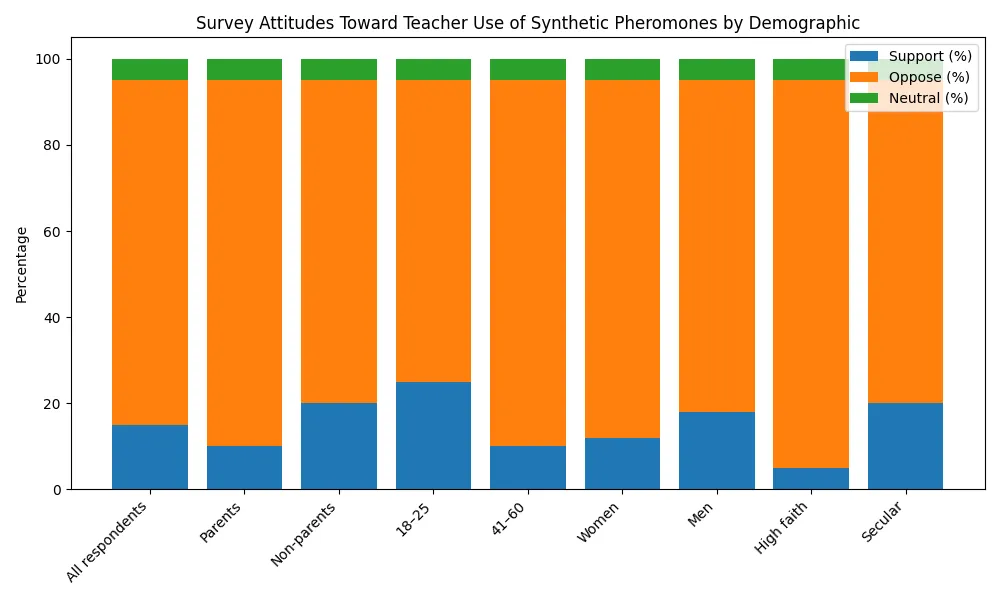
Below is a visualization of support, opposition and neutrality by demographic group. The underlying data are provided in `dataset2-survey_attitudes_summary.csv`.

The figure illustrates that opposition (orange) dominates every demographic group. Even among 18–25 year‑olds, support peaks at only 25 %, while about 70 % oppose and 5 % remain neutral. Parents and high‑faith respondents are even more wary, with 85–90 % opposed. Women are slightly more cautious than men, but both genders show strong opposition. The small neutral group (~5 %) suggests that most respondents have clear opinions on the issue.
## Policy Recommendations
### Legislative Ban and Clear Definitions
Given the absence of proven benefits and the documented health risks, we urge lawmakers to **ban** the use of synthetic pheromones and unlabelled scent diffusers in all K‑12 educational settings. Legislation should define “synthetic pheromone” broadly to encompass any manufactured chemical or device intended to influence mood, behaviour or physiology. The law should prohibit possession, diffusion or administration of such chemicals on school property, except for approved medical therapies with informed consent.
### Transparency and Consent Protocols
For any future intervention involving bioactive substances, schools must adopt robust consent procedures. Parents and, when appropriate, students should be fully informed of the composition, purpose, dosage and risks【667774160398977†L116-L134】. Participation should be voluntary with opt‑out options. Teacher use of essential oils or fragrances should be restricted to products vetted by health authorities and disclosed on classroom safety plans.
### Occupational Health and Training
Educators and administrators require training on indoor air quality and the risks of fragrances. Guidance from health departments emphasises avoiding unapproved scents, improving ventilation and using HEPA filtration【610396466728518†L121-L124】. Schools should implement fragrance‑free policies, provide alternatives for stress management (e.g., mindfulness, classroom design) and enforce fire‑safety codes that already prohibit electric diffusers【591998084780423†L170-L177】.
### Research and Monitoring
Public health agencies should monitor fragrance and pheromone products for endocrine‑disrupting chemicals. Further research on human chemical communication should focus on identifying genuine pheromones, if they exist, under rigorous conditions. Until such evidence emerges, caution is warranted.
## Conclusion
Humans may be fascinated by the idea of subliminal chemical communication, but science has yet to confirm the existence of human pheromones【657417579556689†L31-L33】. Meanwhile, products marketed as pheromones often contain essential oils and volatile compounds that pose **real health risks**【610396466728518†L6-L15】. Surveys show that parents, students and teachers overwhelmingly oppose their use in classrooms【309048350874862†L18-L23】, citing ethical, legal and medical concerns. Children cannot provide informed consent【843914784809352†L178-L184】, and covertly exposing them to psychoactive chemicals violates fundamental rights【591998084780423†L190-L202】. Upholding PaP.Arazzi.Me’s commitment to autonomy and safety means rejecting gimmicks and embracing transparent, evidence‑based education. Policymakers should act swiftly to ban synthetic pheromones in schools and ensure that classrooms remain spaces for learning—free from secret chemical manipulation.
## References
1. Daisy Yuhas. *Are Human Pheromones Real?* Scientific American (2014). Lines showing that decades of research have not identified any human pheromones【657417579556689†L31-L33】.
2. Rebecca Trager. *Supposed human pheromones fail to pass sniff test*. Chemistry World (2017). Double‑blind study showing no effect of androstadienone or estratetraenol on perception of gender or attractiveness【572632316940308†L115-L131】【572632316940308†L145-L162】.
3. Johan Verhaeghe et al. *Pheromones and their effect on women’s mood and sexuality.* Facts Views Vis Obgyn 5 (3) (2013). Highlights that humans lack a vomeronasal organ and that mood effects of androstadienone are context dependent【329314454553069†L148-L161】.
4. Endocrine Society. *Chemicals in lavender and tea tree oil appear to be hormone disruptors* (press release, 2018). Reports that endocrine‑disrupting components in these oils are linked to prepubertal gynecomastia in boys【830992670519000†L225-L256】.
5. Washington State Department of Health. *Essential Oils: Guidance for Healthy Classrooms* (2022). Notes that essential oils offer no proven health benefits, emit volatile organic compounds that aggravate asthma and can cause premature breast development【610396466728518†L6-L15】【610396466728518†L19-L22】; recommends avoiding all essential oils in classrooms and using ventilation【610396466728518†L121-L124】.
6. Washington State Department of Health. *School Indoor Air Quality – School EHS Workshop* (2023). States that essential oils, air fresheners and cleaning products can trigger asthma and have been linked to more than 350 cases of work‑related asthma【507850925680027†L460-L463】.
7. PaP.Arazzi.Me. *Protecting Children’s Autonomy and Safety: A Call to Ban Synthetic Pheromones in Education* (2024) [whitepaper]. Argues that no chemicals meeting pheromone criteria have been isolated in humans, warns of unpredictable effects on children, highlights neurodevelopmental risks and emphasises parental rights【591998084780423†L102-L116】【591998084780423†L118-L132】【591998084780423†L136-L146】【591998084780423†L190-L202】.
8. PaP.Arazzi.Me. *Survey Analysis: Teacher Use of Synthetic Pheromones* (2024). Reports that 80–90 % of respondents oppose classroom pheromones and cite health and consent concerns【309048350874862†L18-L30】【309048350874862†L43-L58】【309048350874862†L104-L139】.
9. Merle Spriggs. *Children and bioethics: clarifying consent and assent in medical and research settings.* British Medical Bulletin 145 (1) (2023). Notes that children’s assent does not have the same moral weight as adult consent and that children need others to represent their interests【843914784809352†L178-L184】.
10. John Pugh. *Informed Consent, Autonomy, and Beliefs.* In *Autonomy, Rationality, and Contemporary Bioethics* (2020). Explains that valid informed consent requires adequate information and voluntary agreement; without it, bodily interference is unethical【667774160398977†L116-L134】.
Media & Data Index
Images